How To Set up your G-suit Team Account
Ref: https://zapier.com/learn/g-suite/setup-g-suite-google-apps/

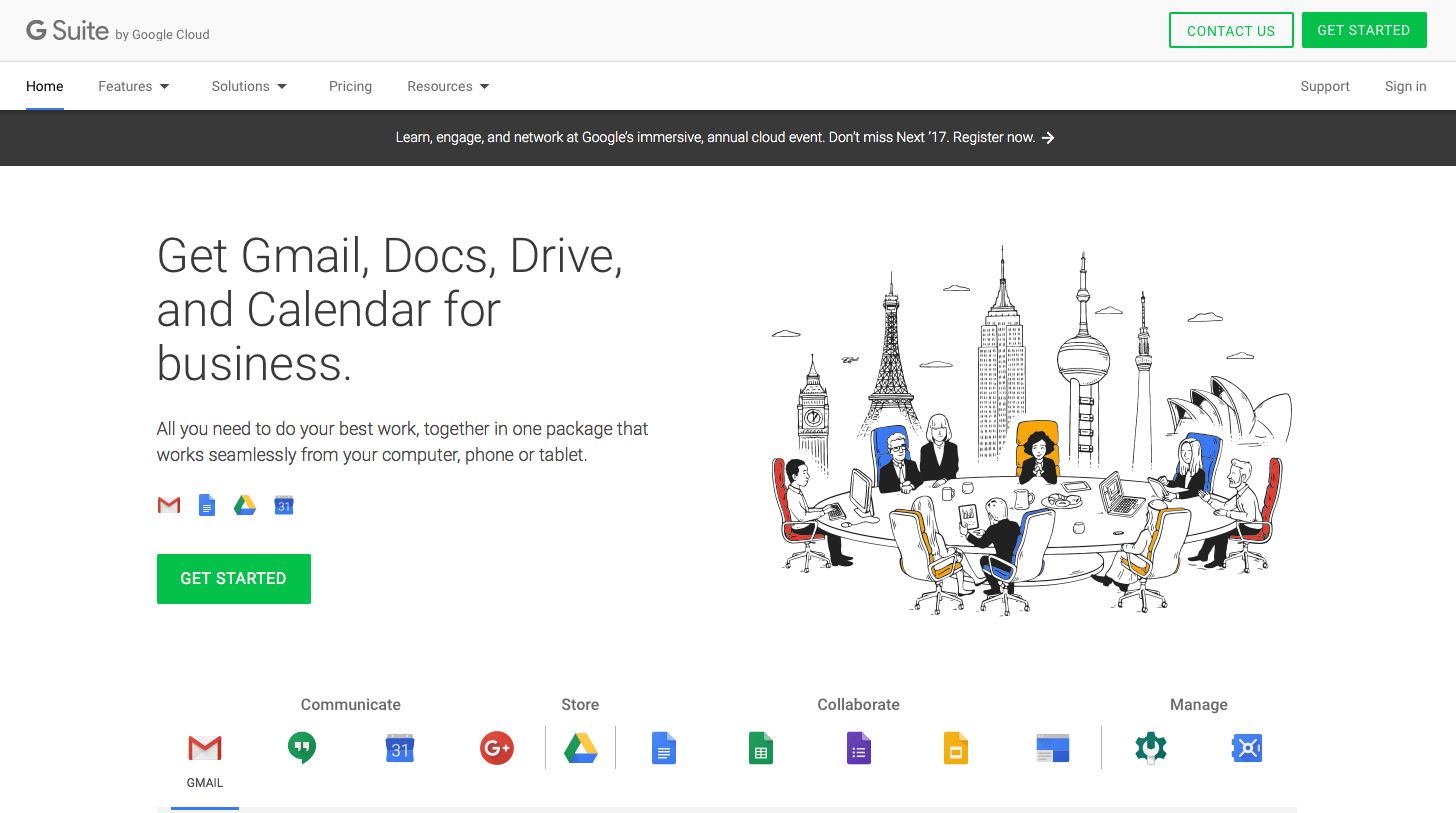



Gmail has served your email needs for years, Google Docs helped you write your most crucial documents, and Google Hangouts let you chat over your ideas with colleagues. But now you've started a company and landed a shiny new domain name. It's time to look professional and email from
@yourdomain.com instead of @gmail.com.
You don't have to leave Gmail—or any of the other Google Apps—behind, though. Instead, with G Suite, you can get all of Google's productivity tools on your own domain. It's the same Google Apps you love, with extra features to help your new team work together better.
All it takes is $5/month per team member, an hour or so to set things up, and perhaps a day for your domain's email to start working.
Let's dig in.
What Is G Suite?
Previously called Google Apps for Business, G Suite is the business version of everything Google offers.
Just as a Gmail account lets you use all of Google's tools for your personal needs, a G Suite account gives you the business versions of the same tools with an email address that uses your company's
.com or other domain address. The online apps look and work the same, for the most part, with your company's logo instead of Google's logo in the apps. And for your company's IT admins, G Suite comes with some extra G Suite sharing and management tools to help your team work together better and keep your data secure.
It's one of the best ways to get email on your own domain, along with the rest of Google's apps that'll help your company members collaborate.
How Much Does G Suite Cost?
Gmail is famously free—as are most of Google's consumer apps—with 15GB of storage for your emails and files. For business email and collaboration, though, you'll need a paid G Suite account.
For most teams, G Suite costs $5 per month per person on your team for a Basic account. That'll give you the full core Google apps experience you'd expect, with Gmail on your company's domain and 30GB of storage per user. It also includes 24/7 online and phone support, along with core sharing and management tools such as team shared calendars and mobile device management with remote wipe.
Need more storage, archive and retention policies for emails, and audit reports to track what your team is doing in G Suite? The $10/month per user G Suite Business plan offers just that, with unlimited storage and archiving for every user.
Either way, you can start out for free with a 14-day trial while you're setting things up, and then can choose the best plan for your team—or start out with Basic and upgrade to Business as your team's needs grow.
Set Up Your G Suite Account
G Suite works great for small or large teams alike
Ready to make your company's G Suite account? Just click the Get Started button on the G Suite site. Enter your company name, and select the number of employees your company has. Don't worry—you can always add more people as your team grows.
Then, select your company's location for locale and billing purposes, and enter a current email address—perhaps the Gmail account you're already using. That's where Google will send your account info after you sign up.
You can then enter your current domain name, or search for a new domain name to use with G Suite if you don't already have one. Google charges $12/year for
.com domain names.
All that's left is making your own G Suite account. Enter your name and an email address you want to use for yourself with your domain, along with a password for your new G Suite Google account. You'll use this email address and password to log into any Google apps in the future.
Google will then give you a phone number to call a Google advisor and let them walk you through the steps of setting up your G Suite account. But it's not that hard—so if you feel comfortable managing your domain name and website, you should be fine setting up G Suite on your own.
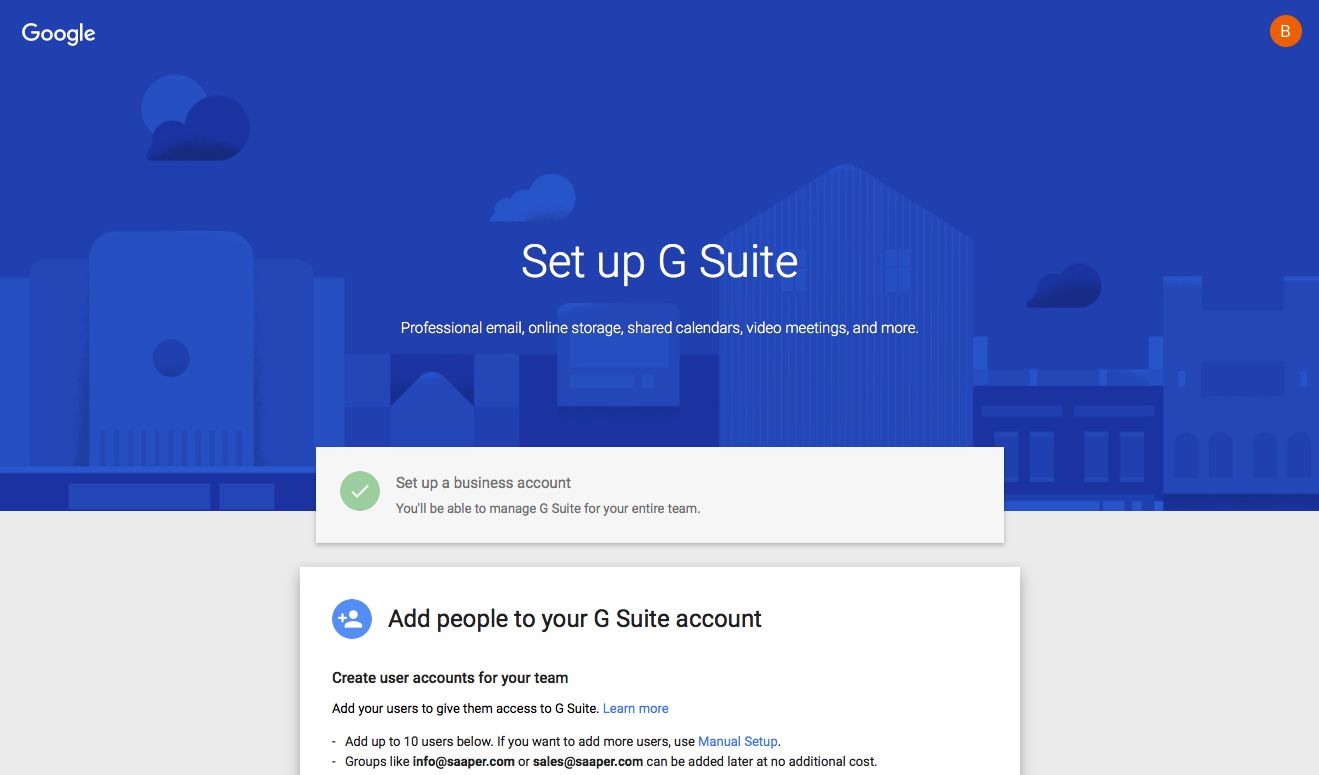
Click Next, and you'll see the G Suite setup screen. It makes setting up the rest of your account as simple as filling out a Google Form.
Add G Suite Users During Setup
You can add your entire team to G Suite now—or wait and add others later
The first step is adding your team to G Suite. You can enter each of your team members' names and the email address you want them to have on your domain. Or, if you want, you can bulk-add them anytime later from G Suite's admin settings.
Either way, check the I added all current users box, and G Suite will show you a template email that it'll send to each new user. You'll need to add each of their current email addresses so Google can send them the info.
Verify Your Domain Name with G Suite
You need to verify your domain name in addition to setting your DNS settings
You're almost done. All that's left now is to verify your domain name and set your DNS server to send your company's emails to G Suite's Gmail.
First, verifying your domain. Google will detect where your domain name is hosted, if possible, and give you the link to log into your domain management page. One of the simplest ways to verify your domain is by adding a
meta tag to your website's header section, or uploading an HTML file to your website's server. The first option is easy if your website is powered by WordPress. Just open your site's admin page at yoursite.com/wp-admin, then click Appearance -> Editor in the lefthand menu, and select Header in the file list on the right. Add the meta tag before the </head> tag in the code editor, and save your changes.
G Suite DNS settings in cPanel, a popular server management app
Then, you'll have to tweak your DNS settings to get Gmail emails on your domain—and you can add an extra record to verify your domain at the same time if you'd rather not add a new meta tag to your site. For that, go to your domain name registrar, hosting account, or server settings, and find your domain name settings. In Digital Ocean, for example, you'll find the DNS settings under the Networking options. With many shared or VPS hosts, you'll use cPanel to manage your site—and it has a dedicated DNS settings page.
Either way, add the DNS settings Google shows in your G Suite setup page, and save the changes. You can then tell Google to verify your domain, and it'll start doing that—with an hour timer counting down until your account is ready.
Manage Your New G Suite Account
Everything you need to manage your team's G Suite accounts
And t


Comments
Post a Comment